Blog

  • How about now?

    I’m almost a hundred percent certain that former Miss Universe Malaysia, Samantha Katie James, was surprised at the predominantly negative reactions she received online from her comments. Her surprise will not have been from the negative reactions but that people condemned her thoughts that are supposed to be a shared idea in the community that she was raised in. It almost sounded like the people criticizing her are anti-racists. If I lived in a different country and only read the comments and saw the reactions online, maybe I would have believed some or any of it.
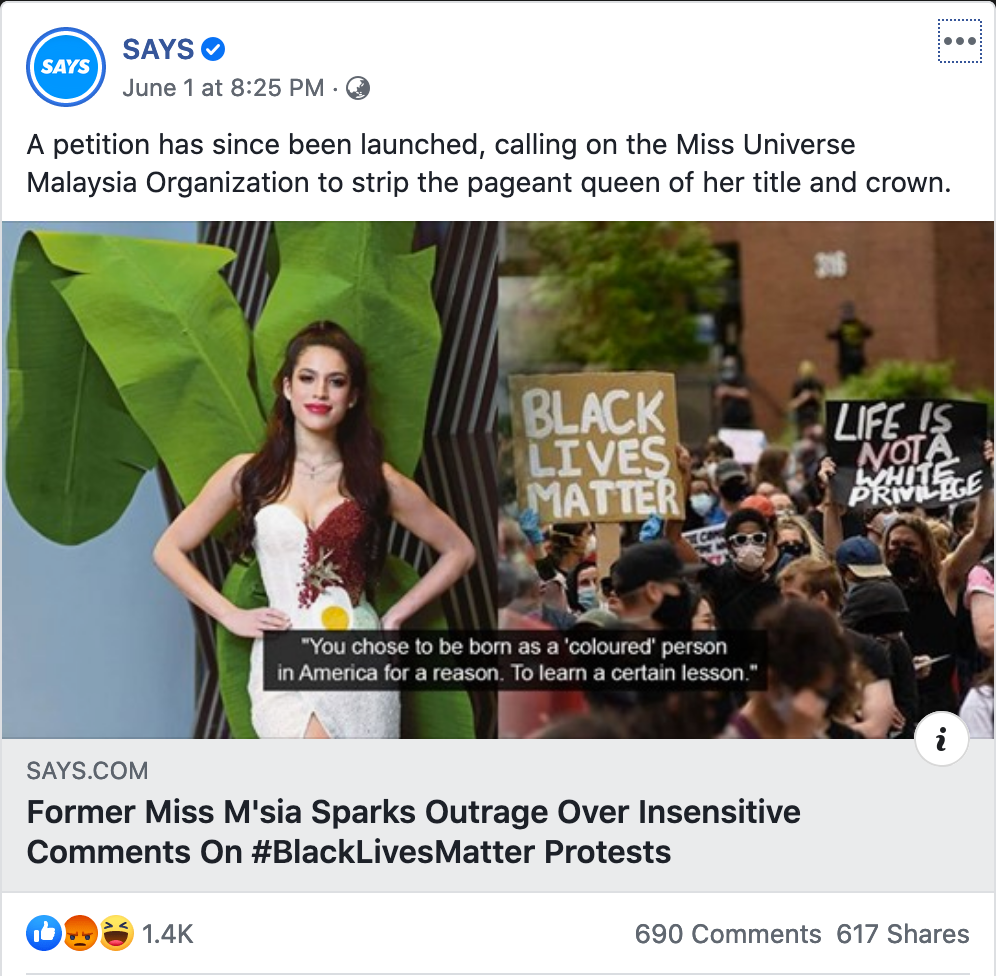
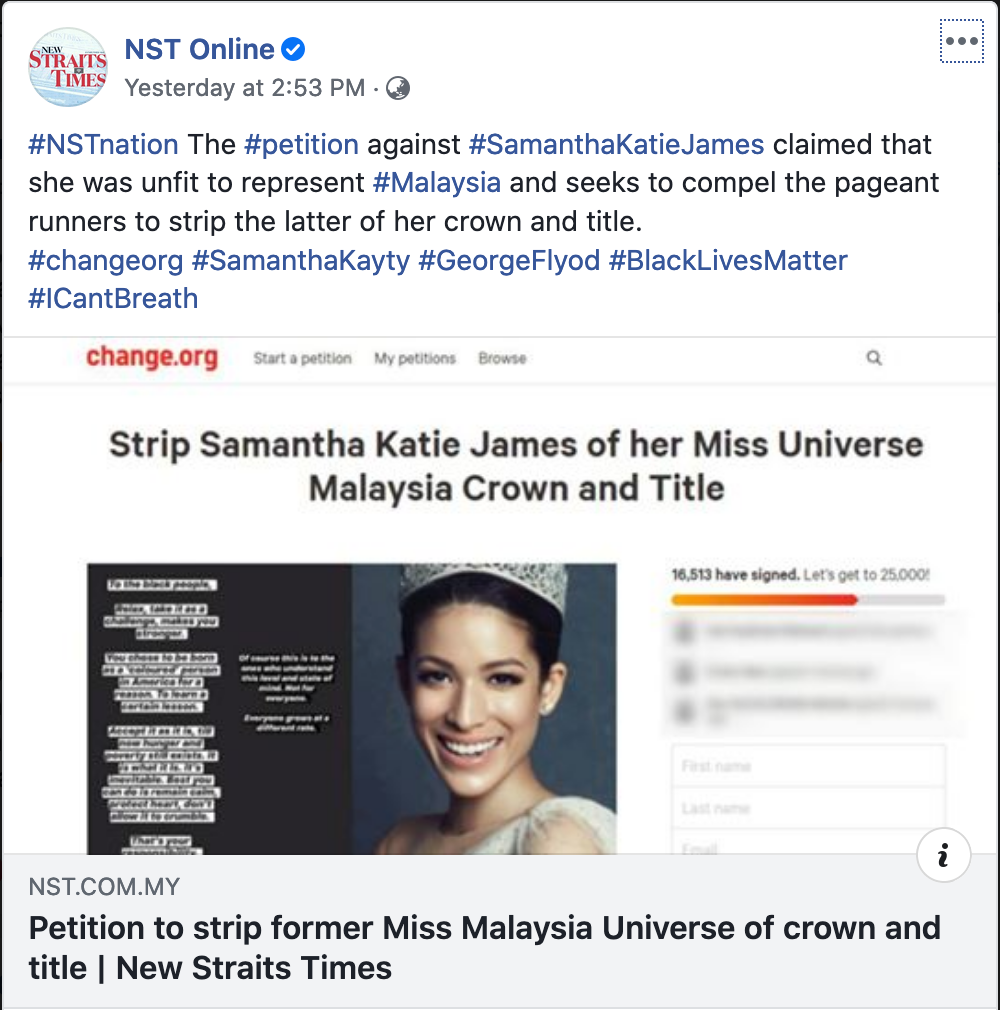
    Sources: SAYS and New Strait Times

    She even got angry before she apologized. Her anger at the reactions of her country people wasn’t feigned. It is the genuine expression of someone who has been betrayed. In her mind, didn’t they all laugh and make fun of the immigrant construction worker who has been forced to return to his country? Didn’t they all laugh and share hearsay stories and say how they were so lucky that the Black person did not make it into the elevator with them because they were quick enough to shut the doors as he approached? Lock the car doors in the center of a crowded open parking lot as the Black couple walked away minding their business? How could these same people now mock her for saying the same thing that they’ll have said, only in the confines of their living rooms, the elevator, or the parked car?
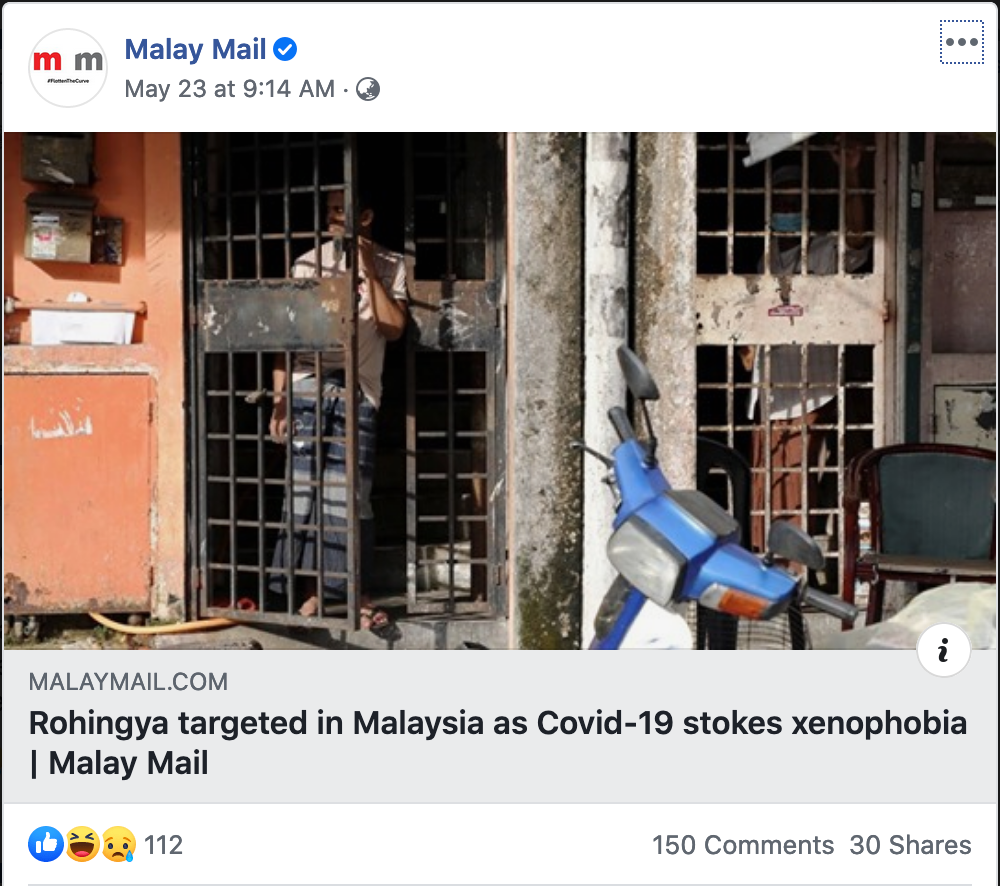
    Source: Malay Mail

    You know my favorite kind of racist? The correct answer should be that that is a trick question and that no one should have a favorite kind of racist but it is 2020, and unfortunately, no one can afford that kind of luxury. Anyhow, my favorite kind of racist is the one that I know, the one, like Samantha Katie James, who owns their ignorance or — what they’ll be quick to tell you — are their beliefs. Because the racists who hide that they are racists know that being racists is a testament of their ignorance and hate towards people who have done nothing to offend them but they are content with remaining racists as long as no one openly knows it.


    And I understand, oppressed people oppress people, although some people seem to relish oppressing people at any chance they get. Many people who are regularly being oppressed pass that oppression to anyone they can. I have come across people who only respect you when they find that you are more fluent in the English language than they are. If, perchance, you so much as stoop their level in the language, you have given them the right to disrespect you. I have no idea how or when a borrowed language became a measure of intelligence or social hierarchy, but that is the world that we live in.

    For many people outside the United States, the protests and challenges that led to it are strictly US problems. If you’re Black in the world, you know this problem because it is your problem and it has always been. Elevators being shut in your face, people crossing to the other side of the street, the stares, your Black body magnet suddenly activating car central locks as you walk past. That last one, I have never really understood, and this especially happens in crowded places. I would completely understand if it were a woman in a car in an empty car park and I (or any man) walk past and she locks her doors. That is safety first and understandable. In a crowded place with several people in the car though, what is your mind telling you is going to happen?


    Samantha Katie James has been comprehensively flamed in the last few hours and she has “apologized,” which should calm everyone down. My issue with all of this is that it will be another ‘death of a celebrity moment’ — the few days following the passing of a celebrity when everyone, including those who have never heard of said celebrity, puts up a picture of said celebrity on their social media account for the likes or to be counted among their peers. The protests in the United States is a humanitarian issue. If you’ve ever lived outside your country and encountered any form of discrimination, you know how much you needed actionable support. That is the support that Black people need right now. Not just a show of hands.

    If nothing, use this as an excuse to understand why and how Black people got to this point. I’m not sure how much I expect from you if I have to first convince you that I am a human being but use it to learn that Black people are people — weird to say but true. Not just go through the motions of Black lives matter and then shut the elevator door in my face or activate the central lock in your car when you see me tomorrow. Try to actually start to change. Try. And start. Because I know many of you have a long history of learning to hate Black people that you’ll need to unlearn. But how about you start now?
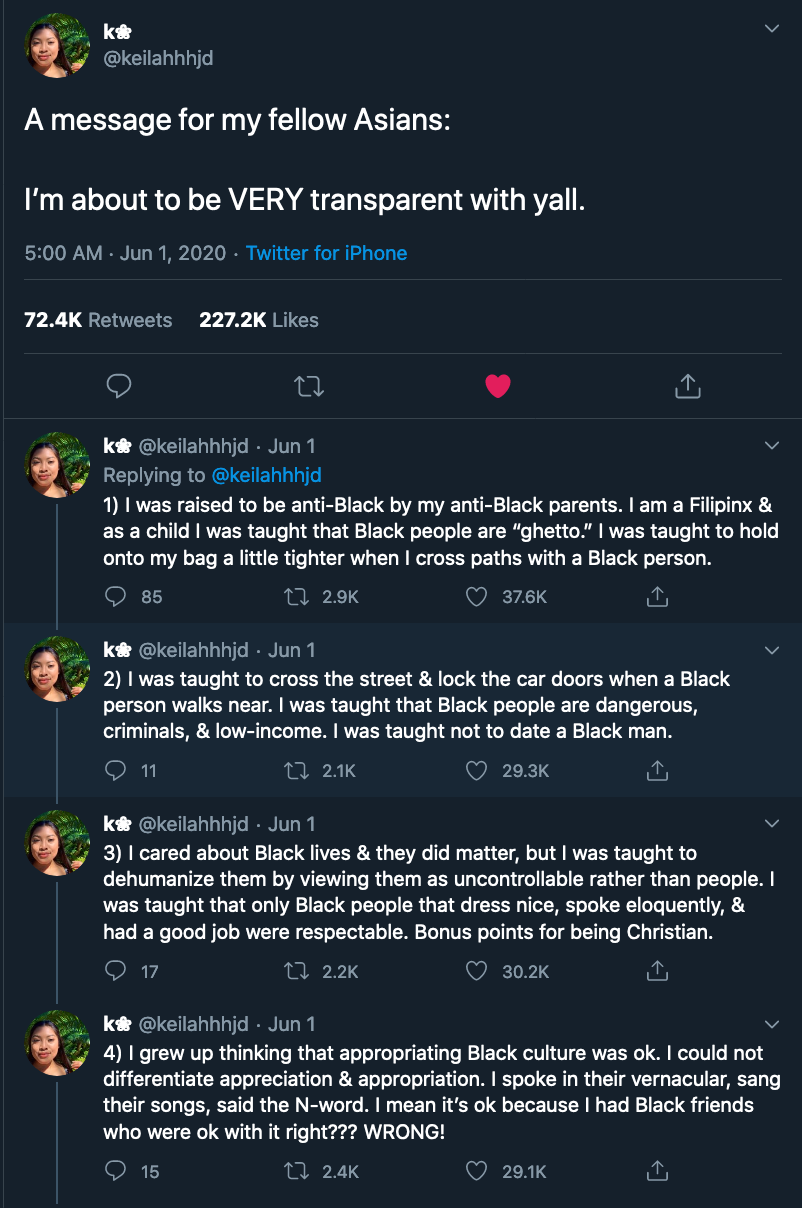

    Source: @keilahhhjd on Twitter
  • In conversation with Jacinta Nalweyiso

    https://www.instagram.com/p/B-JgrZ4Dmpd/?utm_source=ig_web_copy_link

    Our guest on this episode is a graduate of biotechnology from UCSI University in Cheras in Malaysia, currently pursuing a Master’s degree. Jacinta Nalweyiso shares her experience living in Malaysia for four years, and her interests, including singing and stop-motion videos, which are really, really cool!

    https://radiopublic.com/other-expats-6rVKqk/s1!8b37a

    Links to her work where you can follow/connect/support/encourage/motivate her:

    Praise and worship on IG:

    www.instagram.com/i_just_want_to_worship

    Stop-motion on IG:

    www.instagram.com/ruthanstudios

    LinkedIn

    www.linkedin.com/in/jacintanalweyiso


    This episode of the Other Expats podcast was produced by rewordink. The intro soundtrack is by big mean sound machine edited by the small room productions. Subscribe to the Other Expats podcast on Apple PodcastsGoogle Play MusicOvercastPocket Casts and Anchor, and sign up for our monthly newsletters otherexpats.com/subscribe. You can also connect with us and let us know what you think on Facebook, Twitter, Instagram, and LinkedIn or send us an email via hello @ otherexpats.com.

  • In conversation with Carl Kapapiro

    Our guest on this episode of the Other Expats podcast is Carl Kapapiro, co-founder of SNCT Marketing. He spent 12 years in Malaysia, where he earned his Bachelor’s degree in business studies from the University of East London and proceeded to pursue his career in sales and marketing. Carl Kapapiro is currently based in Uganda, where he is continuing his life as an expat while establishing the nation’s premier digital marketing agency.

    Stuff we talked about:

    • He’s only been turned down at one or two job interviews. What’s his secret?
    • Getting used to the food in Malaysia?
    • If you’re in Malaysia, you need to visit Langkawi and the night markets?
    • Why traveling around Southeast Asia and Asia will improve your Malaysian experience.
    • Moving back to Africa.
    • Does ignoring racial problems help better than tackling them?
    • And more

    https://radiopublic.com/other-expats-6rVKqk/s1!65b55


    This episode of the Other Expats podcast was produced by rewordink. The intro soundtrack is by big mean sound machine edited by the small room productions. Subscribe to the Other Expats podcast on Apple PodcastsGoogle Play MusicOvercastPocket Casts and Anchor, and sign up for our monthly newsletters otherexpats.com/subscribe. You can also connect with us and let us know what you think on Facebook, Twitter, Instagram, and LinkedIn or send us an email via hello @ otherexpats.com.

  • In conversation with Emmanuel Okwu

    These are trying times and we hope you are staying safe by following the recommended health guidelines. This is going to be here a while but it will pass.

    Our guest on this episode of the Other Expats podcast, Emmanuel Chisom Okwu, does not talk about “the rona.”

    Emmanuel talks about his experience starting the International Student Council while at the Kuala Lumpur Metropolitan University to change the perception of Malaysians about foreign students, transitioning from student to working, what he enjoys most living in Malaysia, visiting Sabah, and a lot of other stuff you’ll hear when you listen.

    Visiting Sabah and more

    About holders of the Nigerian passport not being allowed to visit Sabah, after this recording, we contacted the Sabah Immigration department, and after being redirected to at least five different officers who made it known that holders of the Nigerian passport are (generally) still not allowed to visit Sabah, we were informed that the final decision rests with the Sabah Minister’s office. On an individual basis, you can apply to the office and they decide if they will allow you into the state.

    We also recently learned that holders of the Nigerian passport are no longer allowed to visit Cambodia (apparently this has been on for the last 2–3 years). If this is a competition to see how fast the Nigerian passport can sink to the bottom of all international lists, I think we’re doing amazingly well.


    This episode of the Other Expats podcast was produced by rewordink. The intro soundtrack is by big mean sound machine edited by the small room productions. Subscribe to the Other Expats podcast on Apple PodcastsGoogle Play MusicOvercastPocket Casts and Anchor, and sign up for our monthly newsletters otherexpats.com/subscribe. You can also connect with us and let us know what you think on Facebook, Twitter, Instagram, and LinkedIn or send us an email via hello @ otherexpats.com.

  • Hobbies and your mental health in 2020

    I’d like to believe that 2019 was the year that mental health finally became something everyone and anyone could share and talk about. I also understand that it’s not going to be that easy.

    Staying indoors all day every day during your days off work (or school) may seem relaxing but it is not the best thing to do for your mental health, which needs some stimulation to be in the best condition.

    It may be especially difficult for expats who are far from home and immediate family, and are more likely to spend extended time by themselves.

    The stimulation does not have to be extreme. Just light doses of happy moments stringed together to give a feeling of hygge (comfortable or satisfying experience). This is where hobbies come in.

    We’ll be sticking with cheap and free hobbies, thank you. Here are a few of those that you can get into in 2020 that won’t wreck your wallet.

    Do comedy

    You may or may not already be as funny as Dave Chappelle or me but that’s the beauty of comedy clubs. Many of them allow you to participate free of charge; all you need to do is register in advance.

    The good news is that you don’t need to be a pro. In fact, comedy clubs have open mic nights for amateurs (like you) to test those funny thoughts on an unwitting audience. You can get an idea of what it is like by attending a few before you sign up to perform.

    You should check out Crackhouse Comedy Club in the Klang Valley area and Penang Players Improv Club if you’re in Penang.

    Get active

    Walk, run, swim, hike, or cycle. Or do all of them if that’s your thing. You would need to spend some money to get the appropriate gear for the activity, but they don’t have to be extremely expensive especially when you’re just starting out.

    If you live in a condominium that has sports facilities like lawn or table tennis, squash, swimming pool (typically), basketball, or futsal, then you already have somewhere to start.

    You can check out sites like Carousell, Lowyat.net forum, or Mudah.my for low-cost gear for your selected activity.

    Want other shopping options? Here’s a list of online shopping sites in Malaysia.

    Volunteer

    You get a wide variety of options and causes to volunteer your support for. You can mentor or just spend quality time refugee children, foster parent pets until they can find permanent homes!!!, share your experiences with rehabilitating ex-cons, or help locals build their homes.

    You don’t even have to stick to only one; you can support and volunteer at as many organizations as you can spare the time for. Variety is the spice of life, they say. You should have at least half a day to spare for most of the volunteer activities.

    They are free to participate in. Just bring yourself. Check out Malaysian Care and Bento Animal Rescues.

    Explore

    Did you know that there’s a (insert something interesting here) around the block from where you live? Maybe. Perhaps not. As part of your walking or running activity, you can start off exploring the places around you.

    There’re also apps (like Geocaching, “the world’s largest treasure hunt”) that allow you to search for and find ‘treasures’ cached in your neighborhood by other geocachers. And there’s District Race, a fitness adventure game that encourages you to explore new places with fun challenges.

    Cook/bake

    Pro-tip: do not allow this to get too expensive!! You can calculate how much you spend eating out every week and redirect half of that fund to cooking your own meals. Half because the variety of eating out will allow you at this for longer and you still have money to eat if you mess up your cooking.

    Hopefully, you already have most of the equipment that you need: pots and pans, and all (or most) of the gadgetry that goes along with them. If you don’t, consider getting only what you absolutely require at the moment.

    In terms of grocery shopping, you get more than a few options in Malaysia. From high-end chains like Mercato and Cold Storage, Village Grocer and Jaya Grocer, to the middle-lower end ones like Tesco and AEON, and of course, wet markets.

    Learn new things

    If you already pay for internet monthly, this can be free depending on what you want to learn. YouTube hosts hundreds of thousands of practical learning videos of almost anything you can think of. If it’s not there already, well your new hobby is to learn ‘it’ and post videos of ‘it’ for others to learn.

    From coding to learning a new language, playing a musical instrument, dancing, swimming, or how to make YouTube videos, you have many hobbies to learn available on the internet.

    Some sites are industry-specific, like Khan Academy for programming but others, like Coursera and edX, are open and have many free courses that you can take and stimulate your mental health.

    DIY

    Instead of calling the plumber to fix your toilet next time, you can learn how to do-it-yourself (DIY). You’ll need tools and equipment for hobbies in this category, so it’s not entirely free.

    You can DIY many things, from fashion to home and car accessories. Things that will be unique to you (think your own Etsy items). You also get the satisfaction of making or fixing something yourself and selling them on Etsy. Unless your hands destroy everything they touch, then stick to other hobbies.

    Places you can learn cheap DIYs include Instructables and YouTube (of course). Don’t forget to share what you made with us.

    Get a side gig

    Or three. You’ve probably heard that the gig economy has been taking off in the last few years. You too can contribute your skills and talents to the thriving community of freelancers by taking on gigs as hobbies.

    It may be difficult for some people to find freelance gigs but you can learn a new skill and then get paid for it. For undergraduates and recent (fresh) graduates, this is especially important; many jobs require you to have some experience. Freelance careers count as valid experience and as hobbies.

    You can find opportunities to practice your new hobbies in places like LinkedIn (yes), Freelancer.my, and ServisHero.

  • In conversation with… Dadje Valere

    “When you travel in a country, the first thing you should do is try to understand and adapt to the culture…” says our guest on this episode of the Other Expats podcast—Dadje Valere, French-speaking Camerounian, and instrument and control engineer who has been in Malaysia since 2009.

    Dadje talks about how he integrates into society, from being active in the university’s students union and the international students’ community to developing and pushing policies that allow foreigners to be heard in the campus environment.

    “The other thing we did was to participate in the homestay program that the Malaysian government was organizing for foreigners to go and stay with local families for some time. So, I spent two weeks with a family in Perlis and that was very interesting because you live the everyday life with the people and you really understand that there is not much difference in the way they live their lives and what we have in Africa.”

    Outside of college, he suggests that you should get yourself some local friends. The idea is that “you benefit from having local friends because you learn about things that you typically are not privy to because you don’t speak the language. Having local friends means you get (almost) free translation services when there’s information that concerns or may affect you.”

    A lot has been said about how foreigners study in Malaysia and expect to find work afterward, and how that is not always the case. Of course, no one promised anyone anything at any point. According to Dadje, “…even though you graduate from Malaysia; it’s like people are telling you to come here and get training but ‘sorry we can’t help you’ after that. It’s like ‘We don’t trust our own training, so go try it somewhere else.”

    https://radiopublic.com/other-expats-6rVKqk/s1!48fa6


    This episode of the Other Expats podcast was produced by rewordink. The intro soundtrack is by big mean sound machine edited by the small room productions. Subscribe to the Other Expats podcast on Apple PodcastsGoogle Play MusicOvercastPocket Casts and Anchor, and sign up for our monthly newsletters otherexpats.com/subscribe. You can also connect with us and let us know how you feel on Facebook, Twitter, Instagram, and LinkedIn or send us an email via hello @ otherexpats.com.

  • In conversation with… Whei Meng, CEO, Speedhome.com

    Whei Meng, CEO of Malaysian-based startup, Speedhome.com, is our guest on this episode of the Other Expats podcast. We haven’t featured a lot of non-other expats, but one of our goals is to provide useful resources for living in Malaysia. Speedhome.com is one of those useful resources.

    In addition, Whei Meng’s Speedhome.com is fighting (or, at least, trying to) what many other expats (and some locals) have encountered in Malaysia: discrimination when looking to rent a property. It’s either “the owner doesn’t want foreigners” (general) or the more specific, “the owner doesn’t want Africans/Nigerians.”

    Whei Meng believes that the homeowners are not necessarily racist, they’re just protecting their properties. From what? Ahhh, you’ll have to listen to find out. Here’s the podcast. Also available on your favorite podcast platform.

    https://radiopublic.com/other-expats-6rVKqk/s1!c66ac

    If you haven’t already, you might also want to see a video we featured in recently that has a similar message. The video, House for Rent: Chinese Only, was created by Malaysian comedian, Kavin Jay, to try to use comedy to tackle racism in the real estate industry.

    See the video on Facebook here.


    This episode of the Other Expats podcast was produced by rewordink. The intro soundtrack is by big mean sound machine edited by the small room productions. Subscribe to the Other Expats podcast on Apple PodcastsGoogle Play MusicOvercastPocket Casts and Anchor, and sign up for our monthly newsletters otherexpats.com/subscribe. You can also connect with us and let us know how you feel on Facebook, Twitter, Instagram, and LinkedIn or send us an email via hello @ otherexpats.com.

  • The Balance of Nature

    The Balance of Nature

    This is the way a new universe is supposed to work, or at least, how the universe has to work, if it is supposed to.

    If all the things in the universe (like every single cell, tree, galaxy, star, planet, etc.) can only be understood if you accept that they were created in some very particular manner, then there is no logical possibility to think that they created at all. If you think about it, we’ve found out a whole lot about the universe (and every single part of it), and we can’t accept anything as fact unless there is a logical reason for it.

    You can’t say ‘it’ created out of nothing until you’ve measured something, or figured out the speed of light and the mass of the sun and the mass of matter that they’re all made of, etc – at that point all we say is ‘something’ creates stuff (and it only works for one case; it can’t be true for every case, since it’s impossible to know what might or might not have happened). So then we either have to accept that everything in nature is random, or if that’s the case, we just don’t expect the universe to continue to be random.

    There’s a real question here, and the best answer is that you should be willing to consider, but don’t think that

    When we talk about animals then they can be considered species, but this is a false and illogical concept. Species do not exist. Humans are one, all animals are one, they are one.

    No wonder people say ‘the woods are the home of the wild’.  So I’ve never been there before, it’s been hard to get here from Seattle. My first few days were amazing, I had a lot of freedom.  I was free to make wild food, to use fire, go where I wanted (like hiking, kayaking, or snowshoeing), to climb any mountain, to just go wherever I thought might be interesting. This was around August.

    So my expectations were way off, my first day of freedom was August 25th.  I didn’t really expect to see any bears there.  I think I was going to kill a little one on my snowshoes, but it just sort of disappeared.

    I guess I’m just the weirdo that likes the outdoors.  I had my dogs with me, they were amazing with their food.  I was taking them for walks, they would run and chase every bit of wildlife they came across, it wasn’t long at all before someone would come running towards them telling them there was a bear.  

  • In conversation with Halima Attahiru

    This episode of the Other Expats podcast features Halima Attahiru, from Nigeria, and currently a revenue management/subject matter expert.

    I think that it is interesting that many other expats in Malaysia don’t associate with locals.

    Does anyone else think that maybe that could help adjust the perception that Malaysians have of foreigners, maybe? People (mostly) fear what they do not know/understand, and if more you make an effort to integrate into the society that you’re in, perhaps the better?

    Maybe it is just an unpopular opinion, but let us know your thoughts in the comments section.

    https://radiopublic.com/other-expats-6rVKqk/s1!1c27b

    Stuff we talked about:

    1.32 – Who’s Halima Attahiru?

    2.35 – Living here for nine years, how different is it from living in Nigeria?

    3.54 – The food wasn’t anything to write home about because it had too much sugar. If you’re an expat in Malaysia, did you have any issues transitioning or eating Malaysian food?

    5.25 – In Malaysia, you don’t water for free in restaurants. You have to pay for water separately *shock*.

    6.07 – Experience as an African woman living in Malaysia?

    7.35 – What does Halima do when she’s not working? Tip: cooks, takes online classes.

    8.10 – Loves cooking African food. Where she lives in Malaysia has a lot of African convenience stores—expensive but available.

    9.50 – What’s one thing every expat should try when they’re in Malaysia?

    10.57 – She works with the airline so she gets to do a lot of traveling within and around Malaysia.

    11.44 – Most and least favorite things about living in Malaysia? The public holidays! And the transportation system.

    15.17 – Who are her crowd in Malaysia; Africans, locals or more of an international group?

    17.24 – What’s most different about living abroad?


    This episode of the Other Expats podcast was produced by rewordink. The intro soundtrack is by big mean sound machine edited by the small room productions. Subscribe to the Other Expats podcast on Apple PodcastsGoogle Play MusicOvercastPocket Casts and Anchor, and sign up for our monthly newsletters otherexpats.com/subscribe. You can also connect with us and let us know how you feel on Facebook, Twitter, Instagram, and LinkedIn or send us an email via hello @ otherexpats.com.

  • Grain and noise texture

    Adding noise to an image is easy and you really can enhance the image. But, to make noise-inducing images that look like nature, sometimes you’ll want to add some grain. Here are a few ways to add grain to an image that have no effect on your image.

    If shadows are just not to your taste, or you just want to make a black and white image, then you can add some shadows to your image. You can add a shadow to the left side of the image, by clicking on it, then choose “Add Shadows”. You can add a shadow to the top and bottom of the image, or the right and left sides. After adding the shadow, you will see a black circle appear in the image you are working on.

    After adding the top and bottom shadow, you will see a black circle appear in the image you are working on.

    This technique is also very effective for adding a bit of movement to an image. It’s best to choose a noise texture and apply it to areas of the image that have a lot of texture, like the leaves of a tree or trees on a mountain.

    The technique I’m going to show here is the first in a series of steps that will eventually show the method behind this tutorial, using a variety of different color palettes to create the various layers of effects.